
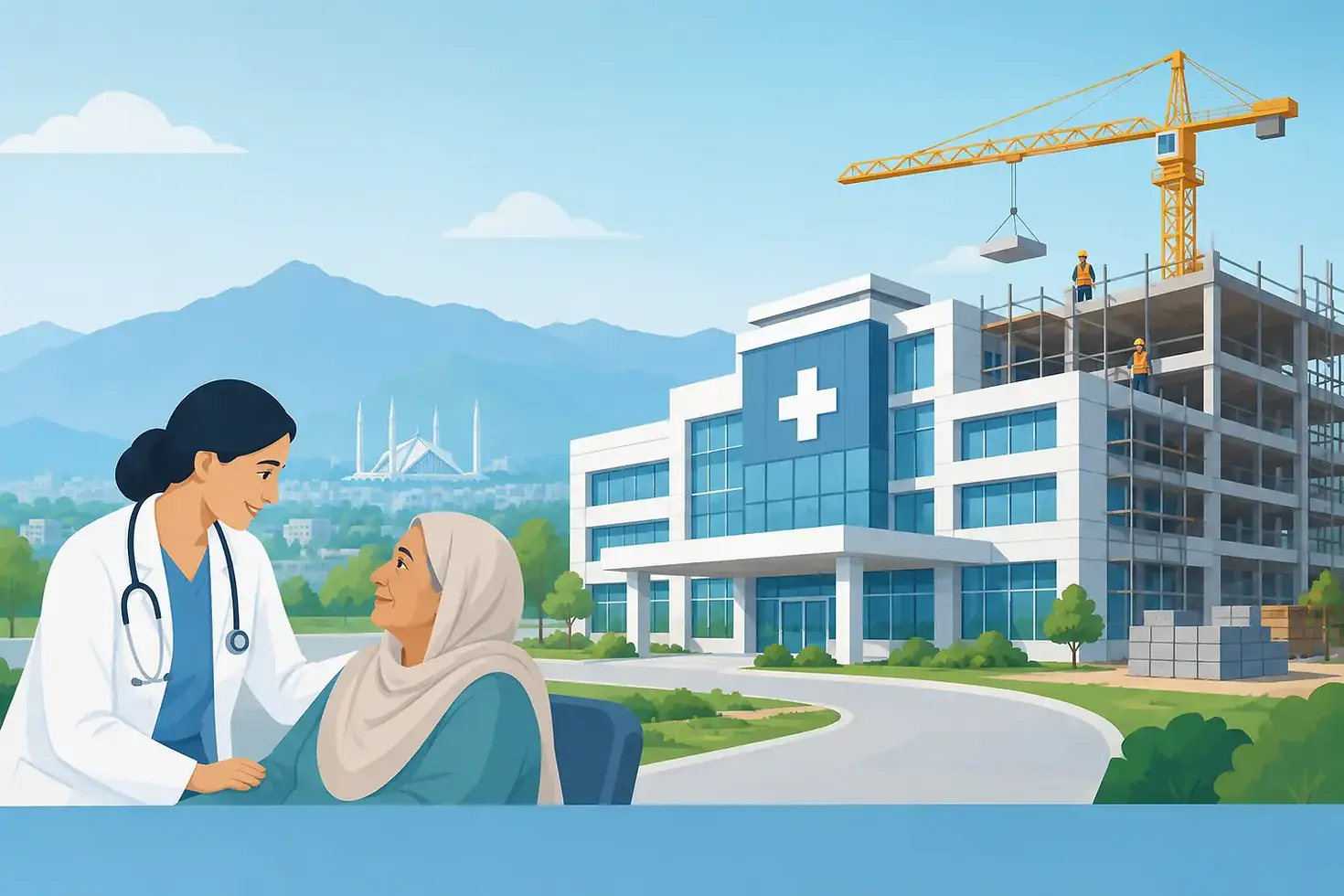
Hospital Construction Pakistan Can Close the Care Gap
For a family in rural Punjab, a medical emergency is rarely only a medical emergency. It can mean finding transport, losing a day’s wages, traveling long distances, and arriving at an overcrowded facility after precious hours have passed. Hospital construction Pakistan is therefore about far more than a building. It is a practical way to bring safety, dignity, and timely treatment within reach of people who have too often been excluded by distance and cost.
In communities around Rangli, Jund, families may need to travel toward Islamabad for services that should be closer to home. The Malik Hameedullah Memorial Trust Hospital and dialysis center is being built 56 miles west of Islamabad to help change that reality. Its planned reach extends to an addressable population of 200,000 people, including mothers, children, older adults, laborers, and patients living with conditions that require regular care.
Why Hospital Construction in Pakistan Is Urgent
A rural health gap is felt one patient at a time. A mother in difficult labor cannot postpone care until transport is available. A child with a serious infection cannot wait for a family to gather money for fuel and consultations. A dialysis patient cannot safely treat a life-sustaining procedure as an occasional option.
Medical camps can provide immediate relief, screenings, medicine, specialist consultation, and referrals. They also reveal the scale of need. But a camp, by its nature, is temporary. A hospital creates a permanent point of care where communities can return for follow-up, diagnosis, treatment, and support.
This distinction matters deeply for chronic illness. Dialysis is not a one-time intervention. It requires consistency, trained clinical teams, safe water systems, dependable equipment, and a setting where patients are treated with respect. The planned dialysis center at Malik Hameedullah Memorial Trust Hospital is designed to serve up to 200 patients daily, creating the possibility of regular care closer to the people who need it most.
The need also reaches beyond dialysis. Rural families require maternal and pediatric services, general medical care, emergency assessment, mobility support, and pathways to specialist treatment. When these services are far away, the poorest households carry the heaviest burden. They may delay care until pain becomes unbearable or a manageable condition becomes life-threatening.
Hospital Construction Pakistan Requires More Than Walls
A charitable hospital begins with construction, but its true value depends on what happens after the structure rises. Clinical spaces must be designed around patient flow, infection prevention, privacy, accessibility, and the practical needs of doctors, nurses, technicians, patients, and caregivers.
A dialysis unit, for example, depends on much more than dialysis machines. It needs reliable electricity, water treatment, drainage, sanitation, backup planning, trained personnel, medical supplies, and maintenance systems. A maternal care space requires privacy, clean delivery conditions, appropriate equipment, and a clear process for emergencies. Every decision made during construction affects whether care can be delivered safely years later.
That is why long-term healthcare infrastructure calls for patience and disciplined planning. Communities deserve more than a ribbon-cutting moment. They deserve facilities that can remain open, responsive, and accountable as demand grows.
The strongest projects also listen to the people they intend to serve. Local residents understand which roads become difficult during bad weather, what transport costs families can bear, and why a patient may hesitate to seek care. Community participation helps ensure that a hospital is not simply placed in a rural area, but becomes part of the area’s everyday support system.
Care That Protects Dignity
Healthcare access is closely tied to dignity. A patient should not have to choose between a necessary treatment and feeding their family. A father should not have to watch his child’s condition worsen because the nearest qualified care is hours away. A person with limited mobility should not be left isolated because assistive support is unavailable.
Human outcomes make the purpose of this work clear. Through a partnership with Braceman P&O, HCF helped a child with quadriplegia receive orthotic support. Such assistance does not erase every challenge, but it can improve comfort, movement, care, and the family’s sense that their child has not been forgotten.
Hospital infrastructure makes more of these outcomes possible. It creates a reliable place where patients can be seen, records can be maintained, treatment plans can continue, and medical teams can build trust with the families they serve.
What Responsible Charitable Construction Looks Like
Donors should expect compassion and clear stewardship to work together. A mission-led project must communicate what is being built, whom it will serve, how the work is progressing, and why each phase matters. Visible milestones, formal partnerships, and documented plans help supporters see that their giving is connected to real work on the ground.
For faith-driven donors, this clarity is especially meaningful. Zakat and Sadaqah are acts of worship as well as acts of service. When directed toward healthcare for vulnerable people, they can help protect life, relieve hardship, and restore hope. The intention behind the gift matters, and so does the care taken to use it responsibly.
Direct-project giving can make the connection especially tangible. When donations are designated to go directly to construction and healthcare work rather than overhead, supporters can understand how their contribution helps move a project forward: a clinic area prepared, equipment supported, a medical camp delivered, or a patient brought closer to essential treatment.
Still, responsible giving is not only about the cost of a single room or machine. It is about supporting a durable system. A hospital needs clinical partnerships, community trust, volunteers, ongoing maintenance, and a plan for delivering care with consistency. The most meaningful impact comes from combining immediate compassion with a commitment to stay present.
Progress Must Be Measured in Lives, Not Only Structures
Construction updates are important because they demonstrate momentum. Yet the greater measure of success is what happens when a family arrives at the hospital. Can a mother receive care without an impossible journey? Can a child be treated before an illness becomes severe? Can a dialysis patient return on schedule? Can a person with a disability find support that improves daily life?
Those questions keep charitable healthcare focused on its purpose. Buildings are essential, but they are not the final goal. The goal is a community where illness does not automatically become financial disaster, where rural location does not mean medical abandonment, and where each patient is met with competence and compassion.
For supporters in the United States, particularly those with family ties to Pakistan, hospital construction offers a meaningful way to turn concern into lasting service. A donation, volunteer effort, professional introduction, or conversation within one’s community can help create care that remains available long after a medical camp has ended.
The next time we consider what it means to give, it may help to picture the patient who no longer has to make a painful journey for treatment. Helping build that possibility is compassion in action, and it is a legacy that can serve rural families for generations.


Comments